The mechanized butchery of the First World War wrought doubt and disillusionment among Europeans of all classes. For T. S. Eliot, the postwar world was a wasteland of despair. “I think we are in rats’ alley,” he wrote, “where the dead men lost their bones.” Indeed, the loss of life and destruction of morale was unprecedented and ever-present. John Keegan writes that “By the end of 1914, four months after the outbreak of the Great War, 300,000 Frenchmen had been killed, 600,000 wounded, out of a male population of twenty million, perhaps ten million of military age…among the five million wounded in the war, moreover, several hundred thousand were numbered as ‘grands mutilés,’ soldiers who had lost limbs or eyes.” Even the pious struggled to grapple with the question of theodicy, with Robert Graves writing that his mother found it “difficult to explain how it was that God permitted wars.”
In such a climate, Christian apologists were forced to answer the question: Where was God in the trenches? Earlier apologists, such as Søren Kierkegaard, had invoked epistemic humility when grappling with the problem of theodicy, arguing that humans are not equipped to fully comprehend the will of God, much like the story of Job. However, this approach was no longer sufficient in the face of the vivid and tangible devastation wrought by World War I. Apologists had to confront theodicy not as an abstract philosophical dilemma but as an urgent, visceral question shaped by unprecedented suffering and loss.
Christian apologetics refers to the rational defense of the Christian faith, aimed at explaining and defending Christianity in the face of opposition, perceived dilution, or misinterpretation of Christian beliefs. The term apologetics comes from the Greek word apologia, meaning “defense” or “an answer given in reply. Apologia appears numerous times in the New Testament referencing professions of Christianity. Notably, Peter’s first epistle offers early instructions for apologetic disciples. In 1 Peter 3:15, believers are exhorted: “Always be prepared to give an answer (apologia) to everyone who asks you to give the reason for the hope that you have.” The New Testament attributes apologia to Paul from a highly idealized account, making significant use of the term in his epistles and referencing his experience in prison. In Acts, Paul provides professions and defenses that fit the definition of apologetics, as well as encourages his disciples to do the same.
This New Testament framework for apologetics, rooted in reason, missionary spirit and devotion, set the tone for the development of the discipline. Over the centuries, apologetics have expanded their form, including philosophical reasoning, experiential testimony, and Biblical exegesis. Nevertheless, they remain alike as vindications of the Christian faith that blend the confessional and intellectual, following the example of the first disciples.
Before the Great War, known as World War One today, Christian apologetics often reflected an optimistic, personal, and confident theological framework, rooted in a belief in progress, rationality, and the individual’s intimate, or community’s localized, relationship with G-d. Post-war apologetics ultimately rejected unreflective optimism and shifted toward a deeper emphasis on divine grace, the pervasiveness of sin, and the centrality of salvation as a corollary to theodicy. This approach ultimately tainted later apologetics as fiercely Evangelical and oriented towards rigid frameworks that situated Christianity as inherently rational and teleological, as opposed to earlier conceptions rooted in wonder and personal devotion.
This shift in apologetic thought was collinear with the rise of radio as a popular, unifying medium. As technological improvements in warfare wrought devastation, so too, did technological improvements transform means of communication. Particularly charismatic apologetics took to radio to capitalize on its burgeoning prowess. Radio was far more intimate and personal than the dominant method of apologetics of the time, which emphasized structured, philosophical arguments. This offered a natural corollary to the aim of apologetics presented in Paul’s epistles, which was to provide guidance towards Christ through an authoritative, but loving mentorship role, similar to that of a Roman-patron.
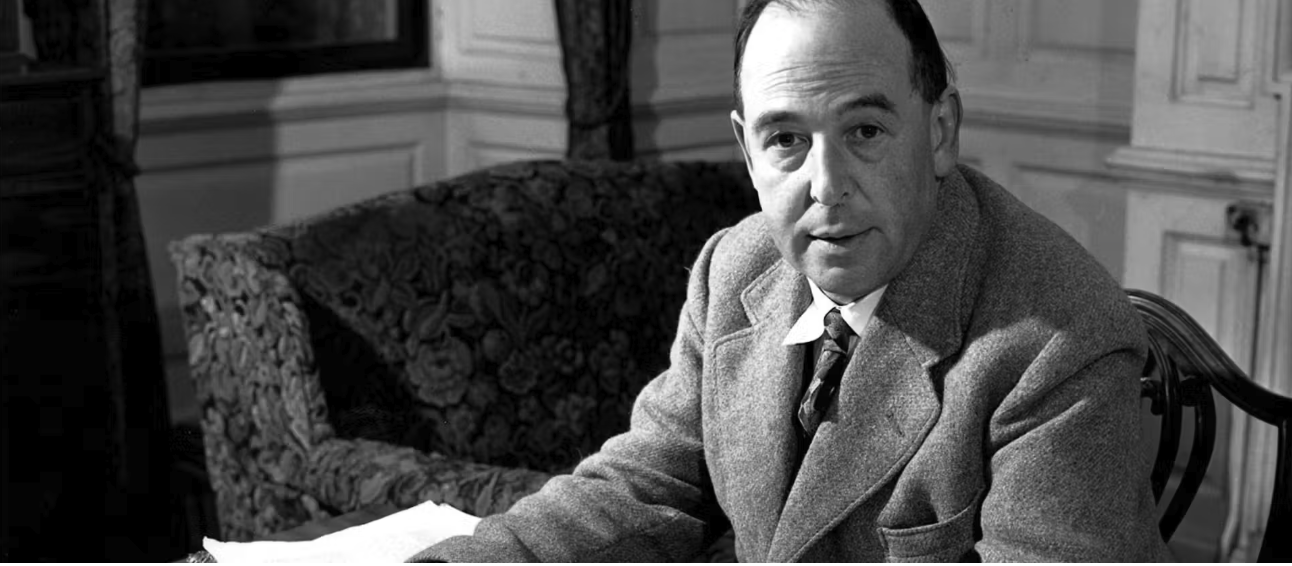
Through his BBC radio broadcasts, C.S. Lewis explored Christian doctrine and argued that the existence of archetypes and morality proved the existence of a benevolent, omniscient G-d. Further, he made operatives such as High Christology and prayer accessible and understandable to a wide audience. To C.S. Lewis, and his personal friend G.K. Chesterton, Christianity was the “key that fits” to reconciling meaning to the inherent order of society.
My waveform analysis takes aim at two of the competing styles of apologetics. One analyzes a surviving BBC broadcast by C.S. Lewis that contemplates the nature of prayer. His address speaks directly to the listener and follows a fire-side chat style. Lewis, once an atheist, appeals to personal listeners, and accepts those who have yet to find Christ as agents of providence. The other is a fiery broadcast by Jerry Falwell, who self-identifies as an Evangelical. This piece structures more as a tirade, as Falwell contrasts those deemed the great inheritors of the Judeo-Christian tradition to those “dark non believers” who do not believe in G-d, and therefore are unfit to operate according to Western values. The contrast is not only palpable via their ideas and delivery, but can also be analyzed via waveform. Lewis is measured, who has an even handed tone and takes natural pause between ideas. Lewis modulates his tone when emphasizing an idea. The waveform reflects this through a more even wave and pauses between ideas. On the other hand, Falwell’s is far more tempestuous. The pauses are far less traceable and frequent than Lewis, and the entire broadcast is delivered in a charged tone, reflective via the intensity of the waveform.
Different doctrines emerged as apologetics grappled with theodicy and competing modern narratives. Each tried to appeal to Christianity in response to modern pedagogy. One such doctrine in Karl Barth’s high Christology, which he outlines in his Epistle to the Romans. This affirms that faith has an inherent paradox: it is a free, human act that is impossible to understand but must be performed. Therefore, the mediator of Christ must be used to employ faith as G-d intended by sending his son. Another such was a return to Thomistic philosophy that emphasized Biblical inerrancy. Fundamentalism arose as a response to the movement of rationalism. Theodicy refers to the philosophical problem of reconciling an all-powerful, all-knowing, all-good G-d with the existence of evil, which was necessary after the palpable, mass destruction of WW1.
The N-gram of my data reflects the popularity of these doctrines. It demonstrates that fundamentalism piqued interest around the Scopes trial, a case that debated if evolution could be taught in schools. Christology is collinear with Karl Barth and picks up after the publication of his Epistle to the Romans. Moral relativism remains with steady, low interest, but rises closer to the start of WW2. Theodicy hits a peak at the end of WW1, then loses interest, then rises again at the precipice of WW2. Biblical Authority is not expressly popular, but can be inferred through the popularity of Fundamentalism.
A key aspect of radio was its democratization of apologetics, reflected not only in the style of theologians like Chesterton and Lewis, who used layman’s terms to convey nuanced doctrinal ideas, but also in figures like Father Charles Coughlin, who insidiously tried to merge Christian doctrine with ideologies like eugenics and fascism. For example, Coughlin’s broadcasts, which garnered millions of listeners, began as a voice for the marginalized, advocating for social justice and economic reforms in line with Catholic social teachings. However, as his platform grew, so did his embrace of anti-Semitism, fascist sympathies, and eugenics. In contrast, Dietrich Bonhoeffer, a leader of the anti-Nazi Confessing Church, took to the Potsdamerstrasse Radio Station to denounce Hitler’s invasion of Poland and his subversion of Christian ideals.
Although both of these approaches fundamentally held modernity in coneteion with the faith, they took different approaches. Cheseterton, Barth, and Lewis, regarded Christianity as eternally truthful and said that it must be privileged as such. However, Coughlin and Falwell took a Fundamentalist approached that took an aze to everything modern. One faction pled epistemic humility to the “Problem of pain” and emphasized Christ-like acts. However, the other blamed suffering on the “enemies” of Christianity. Ultimately, radio provided a medium that made apologetics accessible, as previous writings had only been done with an academic audience in mind. Radio proved to be a powerful tool for shaping public discourse and influencing the direction of Christian theology. Ultimately, the medium made apologetics more accessible but also more susceptible to manipulation.
I am not a Christian, but I have always been fascinated by Christian theology. My dad is Christian, and he grew closer to his faith when he was deployed in Afghanistan. I’ve always loved discussing this with him, so I have a personal connection to the intersection of war and faith.
I first encountered Christian apologetics academically over the summer, when I was the only Jewish person working in an office focused on religious freedom law. The other interns and I often shared our favorite books, and I became interested in Christian apologetics after reading works by C.S. Lewis and G.K. Chesterton. I noticed a shift in apologetic style after WWI, which led me to investigate this further through independent study with one of my mentors and my dad.
This class inspired me to consider radio as an apologetic medium, something I had not previously explored beyond published works. Through this analysis, I learned more about how apologetics were used to appeal to and influence political movements, as well as the intended audience.
Leave a Reply